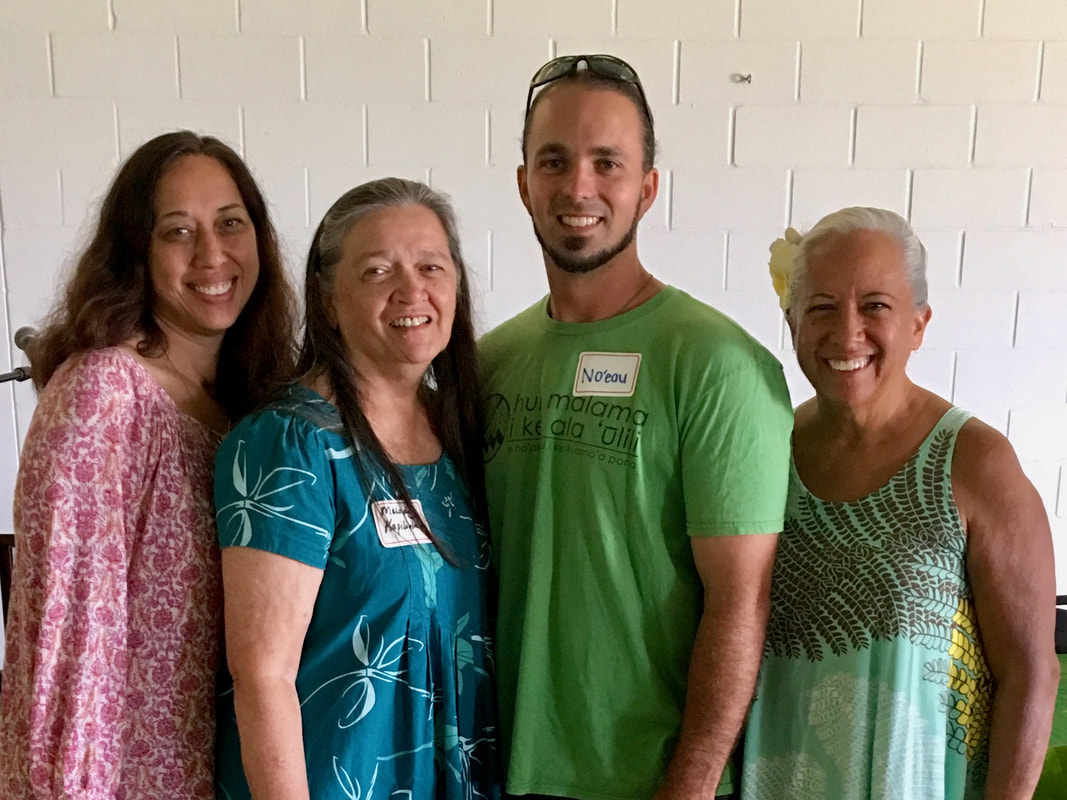
"A gathering of hoaʻāina engaged in caring for lands and waters across Hawaiʻi nei." We were proud to be elbow-to-elbow again with some of our favorite co-conspirators and kīpuka-to-kīpuka warriors, among them: Lehua Lupenui (of The Kohala Center), Pili MacKenzie (of the W.S. Richardson School of Law, Hikaʻalani, and HMI), Noʻeau Peralto, PhD. (of huiMAU), and Māpuana de Silva (of Hikaʻalani and HMI). We gave an opening address, (Māpu and Kīhei), that began with an oli and the following explanation:
Nathaniel Emerson published the mele “‘O ‘Oe nō Paha Ia e ka Lau o ke Aloha” in 1909 in his Unwritten Literature of Hawaii. He interprets it as: “the soliloquy of a lover estranged from his mistress. [The poet’s] imagination,” he says, “is alive in eye and ear to everything that may bring tidings of her, even of her unhoped-for return.” Emerson, as is often the case, completely missed the mark on this one.
The mele is actually an 1850s lament for the departure from Kawainui fishpond in Kailua of the mo‘o-guardian Hauwahine. It was she who brought prosperity to Kailua: a wealth of fat fish in the pond, and field after field of healthy kalo spreading inland from its banks. It was Hauwahine who made a simple covenant with her people: If they lived in pono, she would look after them. If they fell from pono – from harmony with each other, their land, and their akua – then she would leave, and everything would fall apart.
The chant is voiced by a man who speaks for all of Kailua’s ‘ōiwi. He catches a glimpse of what might be Hauwahine – or at least of the yellowing leaf tips that are a sign of her presence. But it can’t be her. The pond is clogged with limu, its banks are littered with ʻōpala ‘ai (edible trash: rice, not kalo), and we surviving Hawaiians are mea ‘ē, are ‘alu’alu, are the estranged, flabby remnants of our former selves. The poet asks: if she were to return, who among us would recognize her. Who would cry in greeting? Who would wail in sorrow?
“‘O ‘Oe nō Paha Ia” is about estrangement, but estrangement on a much larger and more distressing scale than that of Emerson’s lovers. It is about how Kailua has almost been lost to us. But not quite. Not while we have a say. We have taught this mele, danced this mele, shared this mele for over 40 years. We do it in hope, not despair. We work for the return of Hauwahine and her pono. We are among those who would still recognize her and cry out in greeting and joy.
Read more about "ʻO ʻOe nō Paha Ia" on our Mele page.
Nathaniel Emerson published the mele “‘O ‘Oe nō Paha Ia e ka Lau o ke Aloha” in 1909 in his Unwritten Literature of Hawaii. He interprets it as: “the soliloquy of a lover estranged from his mistress. [The poet’s] imagination,” he says, “is alive in eye and ear to everything that may bring tidings of her, even of her unhoped-for return.” Emerson, as is often the case, completely missed the mark on this one.
The mele is actually an 1850s lament for the departure from Kawainui fishpond in Kailua of the mo‘o-guardian Hauwahine. It was she who brought prosperity to Kailua: a wealth of fat fish in the pond, and field after field of healthy kalo spreading inland from its banks. It was Hauwahine who made a simple covenant with her people: If they lived in pono, she would look after them. If they fell from pono – from harmony with each other, their land, and their akua – then she would leave, and everything would fall apart.
The chant is voiced by a man who speaks for all of Kailua’s ‘ōiwi. He catches a glimpse of what might be Hauwahine – or at least of the yellowing leaf tips that are a sign of her presence. But it can’t be her. The pond is clogged with limu, its banks are littered with ʻōpala ‘ai (edible trash: rice, not kalo), and we surviving Hawaiians are mea ‘ē, are ‘alu’alu, are the estranged, flabby remnants of our former selves. The poet asks: if she were to return, who among us would recognize her. Who would cry in greeting? Who would wail in sorrow?
“‘O ‘Oe nō Paha Ia” is about estrangement, but estrangement on a much larger and more distressing scale than that of Emerson’s lovers. It is about how Kailua has almost been lost to us. But not quite. Not while we have a say. We have taught this mele, danced this mele, shared this mele for over 40 years. We do it in hope, not despair. We work for the return of Hauwahine and her pono. We are among those who would still recognize her and cry out in greeting and joy.
Read more about "ʻO ʻOe nō Paha Ia" on our Mele page.